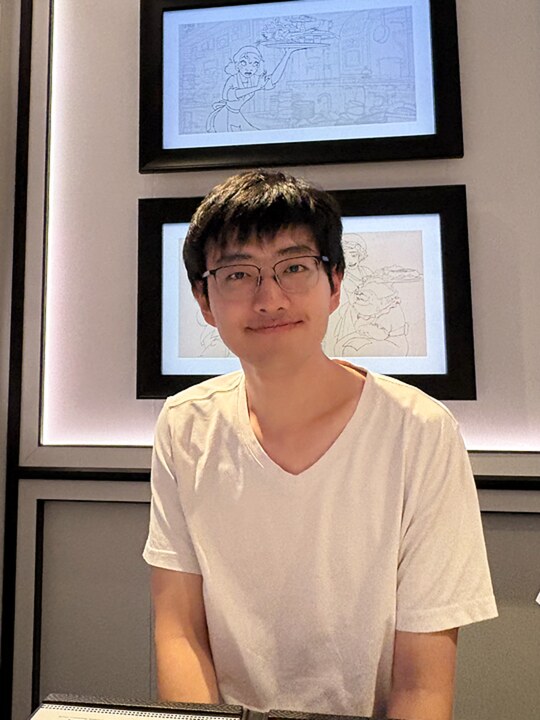
Hu Tianrun

Hu Tianrun

Incoming PhD Student (Fall 2026)

School of Computing @ NUS

Research Engineer @ Smart System Institute (SSI)

"wait, this actually works?"

Email: tianrunhu@gmail.com, tianrun@nus.edu.sg

Office: Smart System Institute, Innovation 4.0, #06-01C, 3 Research Link, Singapore 117602

About Me

I am an incoming PhD student (Fall 2026) at the School of Computing, National University of Singapore, where I have been awarded the A*STAR Graduate Scholarship (Computing). I am currently a Research Engineer at the Smart System Institute (SSI), supervised by Prof. David Hsu. I work closely with Dr. Hanbo Zhang while at NUS. My research focuses on mobile manipulation in the real world, particularly the coupling between perception and action. Previously, I was an undergraduate in Computer Engineering at the College of Computing and Data Science (CCDS), Nanyang Technological University under the guidance of Prof. Lam Siew Kei. During my undergraduate studies, I worked with Dongshuo Zhang.

Research Interests

My long-term research goal is to build mobile manipulators that act robustly in the unstructured real world. In the real world, perception and action shape each other. What the robot sees decides how it acts, and how it acts decides what it gets to see. Treating them in isolation breaks down the moment the environment stops cooperating. I am interested in jointly reasoning about perception and action, building principled frameworks that scale this kind of reasoning to the complexity of real environments.

Joint Reasoning over Perception and Action Can we reason about where to look and how to act under one unified objective, instead of treating perception and action as two separate pipelines?
[Visibility-Aware Mobile Grasping] preprint. Joint gaze and base-motion planning under limited directional sensing to grasp objects in dynamic environments.
[Unified Seeing, Avoiding, Grasping] ongoing. A probabilistic formulation that casts the three operations as expected overlap between future probability fields, with gaze maximizing collision risk to expose it and motion minimizing execution risk.
Scene Understanding for Action Scene representations and grounding are often evaluated as pure vision tasks and then adapted to action. I want representations that are designed for action from the start, so the loop closes from the perception side as well.
Action-Oriented Object Representations
[MimicFunc] CoRL 2025. Functional correspondence as a perception representation built for tool use, transferring from a single human video.
[Chain-of-Action] NeurIPS 2025. Trajectory autoregressive modeling anchored on key object states, tying the state representation directly to action.
[Object-Centric Policy] ongoing. Contact points and spatial vectors in object coordinates, transferring across embodiments and viewpoints.
Scene Representations and Grounding
[Dynamic Scene Graph] ongoing. Relational scene structure that tracks object states under partial observation to support long-horizon planning.
[Uncertainty Estimation for Visual Grounding in the Open World] in submission. Calibrated uncertainty over open-world grounding so that downstream planning can reason about what the perception system does and does not know.
Reasoning for Complex Real-World Tasks Extending joint reasoning from single-skill mobile grasping to open-world, multi-step tasks that a robot has to handle in homes and public spaces.
[Hypothesis-driven Model Expansion under Uncertainty] RSS 2026. Reasoning over hypotheses about an open-world environment and expanding the planning model on demand.
[Robi Butler] ICRA 2025. Remote multimodal interaction with a household robot assistant via language, gesture, and demonstration.

Get in Touch

Whether you're a fellow researcher looking for cooperation, an undergrad figuring out research or PhD applications, or just starting out and not sure where to begin, feel free to shoot me an email. I read and reply to every one, always happy to chat!